Certainly, solidarity has its strong points, especially when contrasted with an overemphasis on atomistic individualism and narrow self-interest. Yet I believe that a narrow focus on solidarity also has its drawbacks, both as an intellectual stance and in its efficacy in achieving desired outcomes.
Traditionally, teaching transmission adds one’s name to the list of Zen “patriarchs.” Perhaps this isn’t the greatest image for here and now…
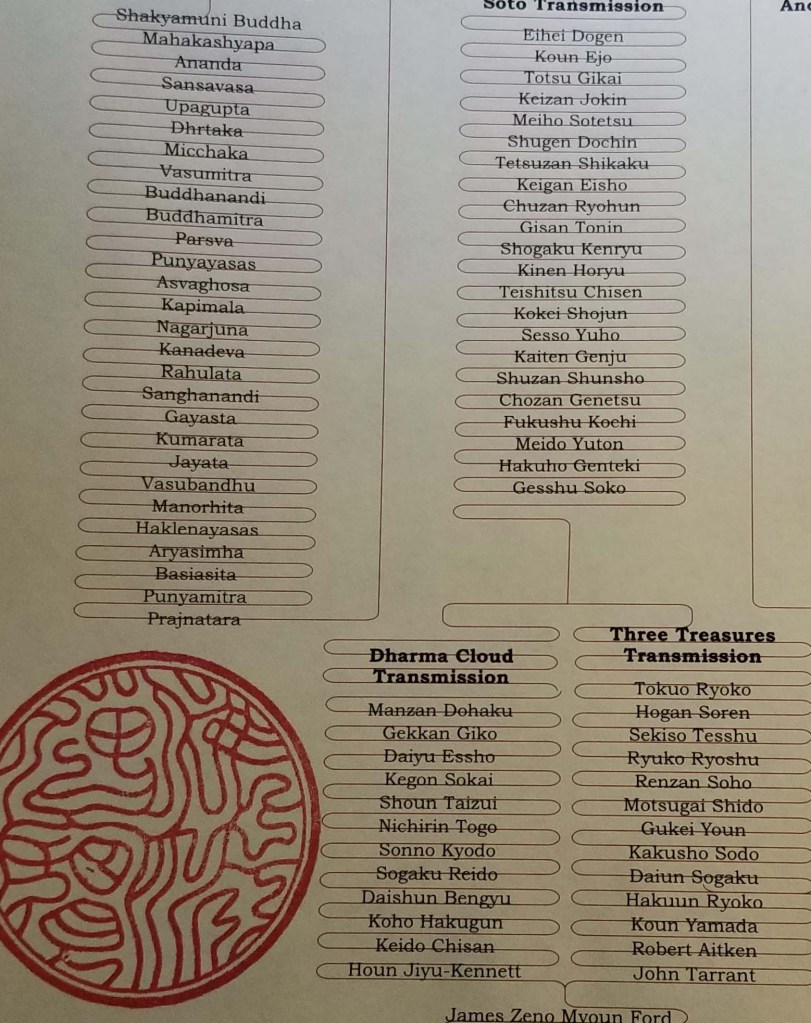
Lineage charts (kechimyaku) play important roles in Zen ceremonies. These purport to show a direct line of transmission all the way from Shakyamuni Buddha, through ancestors in India, China, and elsewhere, and ending with the recipient of the chart. A red “bloodline” connects the names. The word patriarchs, from the Greek for “ruling father,” is traditionally synonymous with ancestors, since all but some very recently recognized ancestors are men.
Students receive a lineage chart when we receive the Buddhist precepts (ethical teachings) in the ceremony of Jukai. The relevant use of the term transmission for this discussion, however, is at the ceremonies of teaching transmission from a fully transmitted teacher to their “Dharma heir.” A teacher who receives full transmission becomes an “ancestor” themself if they convey teaching authority on to further “heirs.”

 Julie A. Nelson