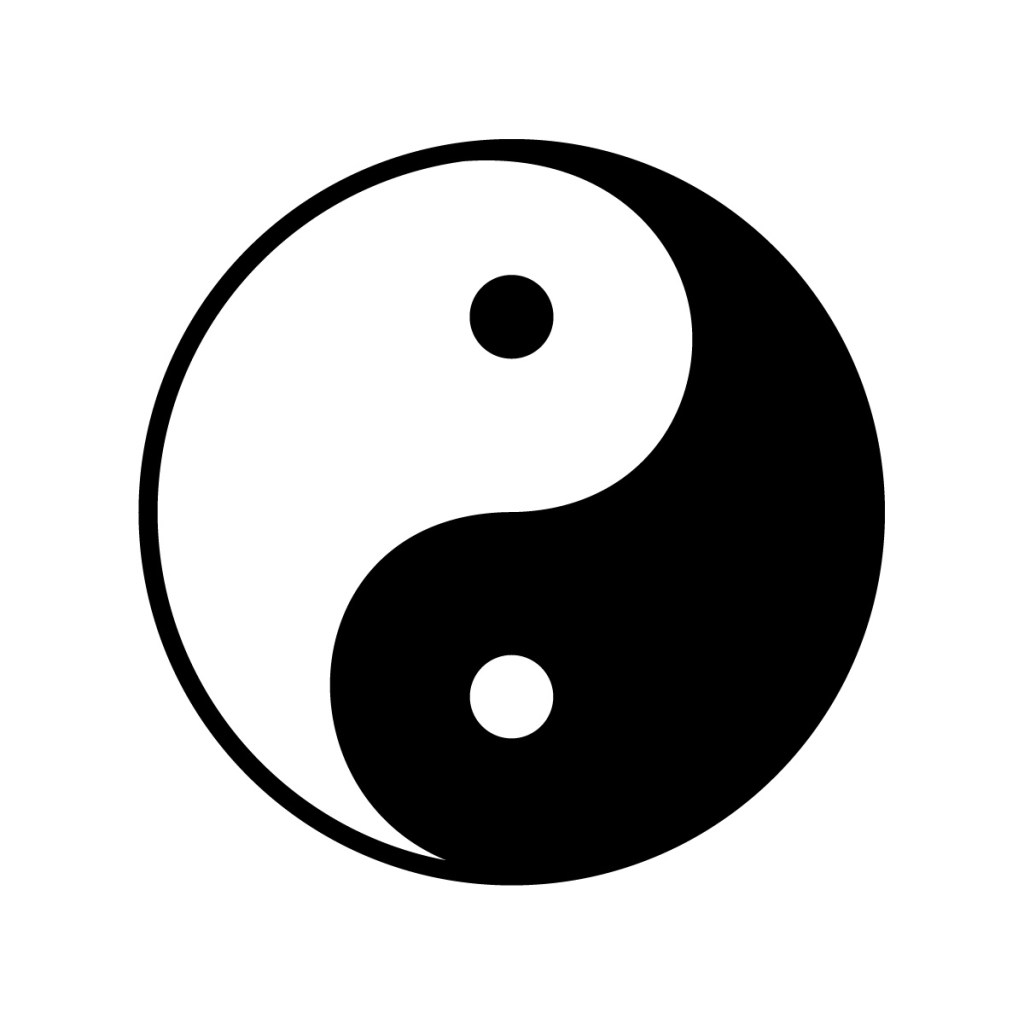
While the metaphor of the ocean (oneness) and the waves (many) that temporarily arise is a wonderful illustration of nondualism, it doesn’t spawn much further understanding. The ancient Chinese yin-yang diagram (shown here), associated with Daoism, highlights more dimensions.
In our habitual “entity” thinking (explained in Non-Duality Part I), the two sides of pairs such as black/white, true/false, and me/you are strictly distinguishable and even thought of as opposites. The yin-yang diagram, in contrast, shows a more complex relationship between black and white: One circle contains both; the black and white shapes inside resemble teardrops or tadpoles; and each has a dot (or tadpole eye) of the contrasting color.
In Chinese philosophy, the diagram illustrates how many things we think of as opposites are actually complements—are actually interconnected, interdependent, and two sides of a dynamic whole. White represents yang energies, associated with lightness, activity, positivity and also, traditionally, maleness. Black represents yin forces, associated with darkness, receptivity, negativity and also, traditionally, femaleness. So, yes, we are back into binary contrasts…but now related in a very different way.
In a yin-yang understanding binaries are neither static nor mutually exclusive. The teardrop shapes in the diagram are meant to suggest swirling movement. I like to see it as two tadpoles swimming in circles in a very tiny fishbowl. This movement evokes the Buddhist teaching of impermanence (anicca): Nothing stays in place. The tadpoles’ contrasting “eyes” illustrate that there is always yang within yin, and yin within yang, just as there is “no self” (anatta)—no distinct essence of self—but only dynamic relationship. We are not “either/or” but “both/and.”
There is much more to this diagram, as found in Chinese philosophy and traditional medicine. But since I’m centrally concerned with Zen and Zen communities, let me here use it only to unpack one brief text.
Dogen and Yin-Yang
Eihei Dogen (1200-1253) was the founder of Soto Zen, the stream of Zen with which my own community is associated. Yet much of his writing is regarded as impenetrable by beginning Zen students—and often advanced ones as well! We sometimes refer to our Dogen reading groups as “Dogen support groups.” We may fall back on considering them to be, perhaps, simply meant to be poetic and evocative.
David Brazier, in his book The Dark Side of the Mirror, argues otherwise. He claims that Dogen uses concepts and metaphors that had obvious conceptual meanings for religiously- or philosophically-inclined readers of his time. These included Daoist ideas and yin-yang.
Consider, for example, the first three lines of Dogen’s important essay, Genjokoan (in Shohaku Okumura’s translation):
As all things are Buddha Dharma, there is delusion and realization, practice, birth and death, and there are Buddhas and sentient beings. As the myriad things are without an abiding self, there is no delusion, no realization, no Buddhas, no sentient beings, no birth and death. The Buddha Way leaps clear of the many and the one—thus there are birth and death, delusion and realization, sentient beings and Buddhas. Therefore, flowers fall even though we love them; weeds grow even though we dislike them.
You got that, right? “There is”…”there isn’t”…”there is” again. And how the heck do the flowers and weeds fit in? In our habitual either/or way of thinking, this passage makes no sense at all.
But let’s re-examine it using the view of yin and yang, as Brazier does. Here’s the first line:
As all things are Buddha Dharma, there is delusion and realization, practice, birth and death, and there are Buddhas and sentient beings.
So here we have “the many.” We have a list of dualistic contrasts: delusion as distinct from realization, birth distinct from death, and so on. The yin-yang diagram similarly encompasses dualism (black vs. white), and so acknowledges the variety of distinct forms. This sentence also has yang dimensions. We need light to see distinctions. There is also a call for action: Practice is something we need to do.
The next sentence points to another aspect:
As the myriad things are without an abiding self, there is no delusion, no realization, no Buddhas, no sentient beings, no birth and death.
Here we have “the one.” We may understand this experientially in moments of kensho or satori: We may feel it way down into our bones, hear sounds more intimately than we ever have before, or really touch the earth. We then understand that all the dualisms in our everyday experience are conditional and temporary, there being no permanent essences by which to make distinctions. This line is also has a yin element. There is no “realization” to be actively pursued. We are in “the mystic Darkness [within which] senses fuse, and objects and opposition disappear,” as Ming Dynasty era Zen master Boshan expressed it.
Often people confuse the mystical experience of oneness with the universe with the apex of spiritual development. This is not the Zen understanding. Dogen continues:
The Buddha Way leaps clear of the many and the one—thus there are birth and death, delusion and realization, sentient beings and Buddhas.
We are warned not to cling to that oneness! As Boshan wrote, if you get stuck in the “mystic darkness…innumerable Buddhas …won’t be able to save you.” After all, after an experience of kensho, we’re still in our own human life. This means we are still going to die, still going to be deluded, and still not always going to act like a Buddha. So we need to act, as well as receive. We need to be responsible for our own individual actions, as well as recognize our oneness. Yang and yin. Neither is excluded.
And what is this all philosophy supposed to illuminate? Nothing other than our lives as they are:
Therefore, flowers fall even though we love them; weeds grow even though we dislike them.
The Buddha taught about three characteristics of existence: non-self (anatta) and impermanence (anicca), mentioned earlier, and dukkha (suffering). No matter how much philosophy we study or enlightenment we gain, the world still refuses to behave the way we think it should. Our practice helps us face into that. Working out the consequences of realization in our lives is a life-long spiritual process.
Continued in Part III.

 Julie A. Nelson
Hi Ma’am,
I started my zen journey long time ago by reading ‘The Authentic Gate’. Since, I’ve been practicing zazen / shinkataza, without a teacher.
I got enlightened, in 2023.
In 2024, I realized something along the lines of the process and destination being joined in me, but not necessarily for the world. I wrote about my thinking, here.
This would mean I continue the path, internally connected.
Given that verifying enlightenment (for the sake of verification) is a form of attachment, I let that go, too. I was in an odd position, since no one could confirm it, but having it confirmed signaled attachment anyway. But yes, I did hope to be verified by a sensei, after chasing for so long, and being 99% sure of the result, haha!
I found another post on your blog today, and read a lot more just now. I see a parallel in our thinking, on the points of:
1. responsibilities post-enlightenment / ethics,
2. why am I encouraged to practice zazen before Kenjustu, a martial art of a violent weapon?
3. duality versus non-duality, and the relationship between the two.
This brings me to my question, and I am hoping you will give me your honest thoughts on it.
Do you think complete, constant enlightenment is possible?
I am beginning to think enlightenment is impossible, but merging the path to enlightenment, with enlightenment, is possible.
But, again, will that merger be a permanent state?
Again, I don’t think so.
I think the merger remains complete, until the external world changes its mode of impermanence, leading to a questionable state of completeness for the Buddha.
Based on the 10th ox picture, and the koan ‘before enlightenment, carry water, and chop wood, after enlightenment, carry water, and chop wood’, the final state of enlightenment is a merger with everything that isn’t enlightenment, thereby refuting enlightenment.
I think surprising someone with our enlightenment, in tune of virtues like ‘right effort’, ‘right view’, ‘right intention‘, etc, are more of a verification of enlightenment, because the ‘exam’ lies outside of us, and there is no premeditated desire to enlighten.
So, if we cook something, and someone says ‘This tastes better than anything buddha could have made!’, this is a verification of enlightenment.
Thank you so much for writing your thoughts well on this site. I liked reading them.
LikeLike
No, complete and constant enlightenment is not possible. As I wrote in another post,
…enlightenment is not a matter of “once and done.” The possibility of awakening is in every moment. Once one has experienced a profound opening experience, one is unlikely to ever completely forget it. But one does not walk around then as a permanently enlightened person. One has not entered a new ontological state; kensho is not a culmination. You walk around as a person with a particular memory of insight, which is different from the insight itself. The path starts here, as the lifelong work of integrating such insights into our lives begins.
Confirmation of having had a particular opening experience is not, in my opinion, very important or helpful. We remain limited karmic beings, even while we are also Buddha (whether or not we have realized that we are Buddha). This is our human state. You are right about seeking verification being a form of attachment! Being human, after a profound experience we will want to think we are special and wear our “enlightenment” as a sort of merit badge. When we can giggle when we find ourselves doing this, and get back to cooking, we are loosen those karmic bonds.
LikeLike
Thank you! Wish you well on your journey.
LikeLike