Abuses of power by spiritual teachers continue to happen. Why? How could teaching culture be improved?
In November of 2025 I spoke about building structures to support accountability on the part of spiritual teachers at a webinar. This was sponsored by the Association for Spiritual Integrity (ASI), a group with member teachers from a variety of spiritual traditions. You can find a video recording of the talk and the subsequent group discussion here.
On discerning healthy Buddhist communities from cultish enterprises
This essay was published by Tricycle on March 8, 2025 and is accessible with a free trial subscription. It is adapted from a chapter in my book Practicing Safe Zen.
The liberation that Zen offers is real! Yet, as I explain in my book, Zen practice must be engaged with carefully.
“Practicing Safe Zen imparts a lesson we all will have to learn if we want to truly mature in our spiritual practice…” —Barry Magid, author, Ending the Pursuit of Happiness
“…This is a thoroughly engaging exploration based on deep knowledge of the tradition as well as contemporary research.” —Martine Batchelor, author, Principles of Zen
The book was released in June 2025, and is can be purchased from Indiepubs and other booksellers. With the publisher’s permission, I’ve reproduced (most of) the introduction below. I hope you will be inspired to read the rest!
Those who lead Zen ceremonies are often thought to possess an elevated level of spiritual authority. Is this helpful?
The performance of rituals and ceremonies seems to be a common characteristic of most religions and spiritual practices, and Zen is no exception. Where does the power to perform such ceremonies come from? I think this question deserves a closer look.
Tradition suggests that teachings given by a transmitted Zen teacher carry a special mystical authority. But perhaps we should instead take our inspiration from Manjushri Bodhisattva.
In the Zen tradition in which I started, a senior student could give a “Dharma talk” but only a Sensei or Roshi could give a “teisho.” This latter type of teaching has a certain mystique about it. Should it?
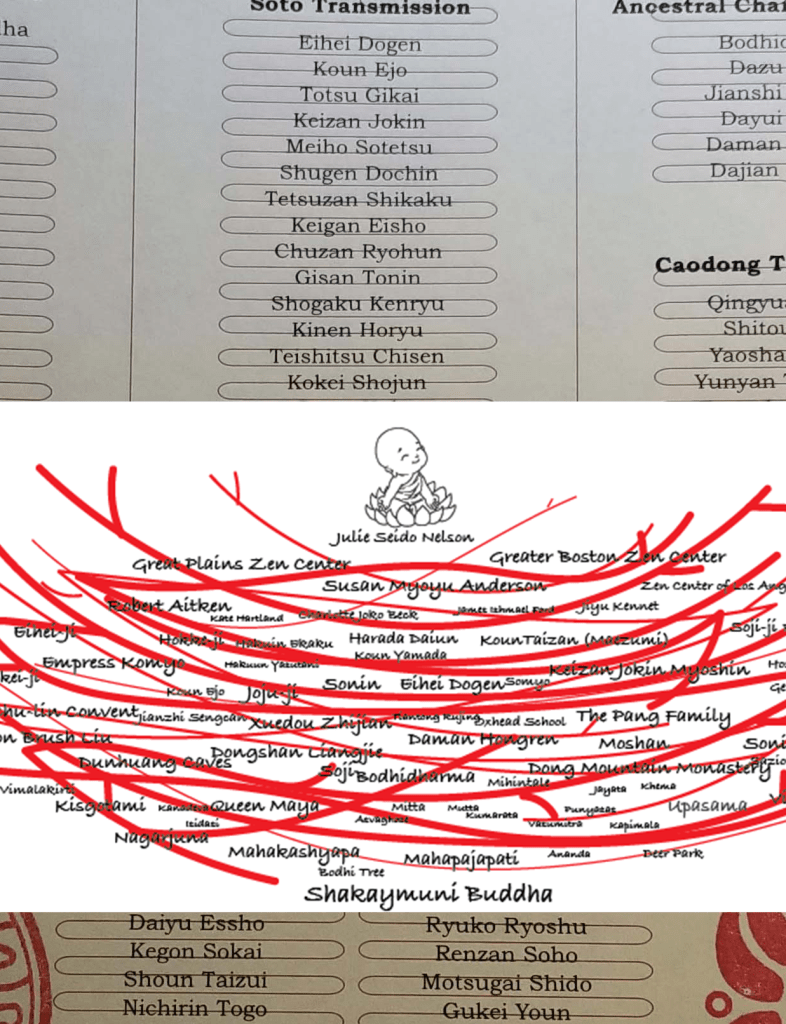
The traditional Zen emphasis on patriarchal lineage is problematic. What if we recognized all who have nurtured us instead?
We are able to practice Zen today because of many the people, places, and communities that sustained the tradition in the past. We do well to remember and honor our Zen history. In the commercialized Western culture in which I live, it’s far too easy to become enamored of Zen as “the next new thing!” We may lean towards forgetting that it’s an ancient tradition.
Yet the way in which this honoring is traditionally done in Zen is highly problematic.
We have met with seemingly endless retaliation for calling attention to abuses of power in Zen. Yet we are surviving and flourishing.
It’s been a crazy time, since my last post. That post, and another attempt of mine to engage in discussion about abuses in Zen, brought forth an unexpected firestorm of angry responses from the three other teachers at Greater Boston Zen Center.
There is much to recommend Nancy Mujo Baker’s new book on the Zen Precepts. And there are some passages I am concerned about. In this, the second of two posts, I want to explain why I find a few passages that touch on abuse of students by teachers to be alarming.
If Zen teaching transmission is not synonymous with enlightenment, and not centrally about mystical power, authority, leadership, or the content or style of teaching…what, then, is the key feature?
In the final analysis, it seems to me that Zen teaching transmission is primarily of teaching responsibility.
The teacher giving transmission believes that the person named as a successor can be trusted to continue the manifestation of the Dharma, and to open the path for others to the best of their ability. They can be trusted to put the teaching of the Dharma and the well-being and development of students above their personal interests. They can be trusted to serve the Buddha by serving the sangha in a teaching role. The successor merits such trust when they truly take on and fulfill these responsibilities.
Perhaps Zen transmission has to do with the content or method of instruction…
While one might think that, since the word Dharma is often defined as “the Buddhist teachings,” that “transmission of the Dharma” meets the passing along of a set of scriptures. But this has never been true, even from the beginning.
According to the old stories, Shakyamuni Buddha’s disciple Ananda, who apparently had a great memory, was able to remember every talk the Buddha gave word for word and so preserve the teachings. But Ananda was not the one who received “Dharma transmission” from Shakyamuni. The next successor in the lineage was Mahakashyapa, who smiled when the Buddha held up a flower. Mutual recognition (see Part (2)) occurred between Shakyamuni and Mahakashyapa, and it was Mahakashyapa who led the community after Shakyamuni’s death.




 Julie A. Nelson