What is Transmitted: (3) Patriarchal Authority?

Traditionally, teaching transmission adds one’s name to the list of Zen “patriarchs.” Perhaps this isn’t the greatest image for here and now…

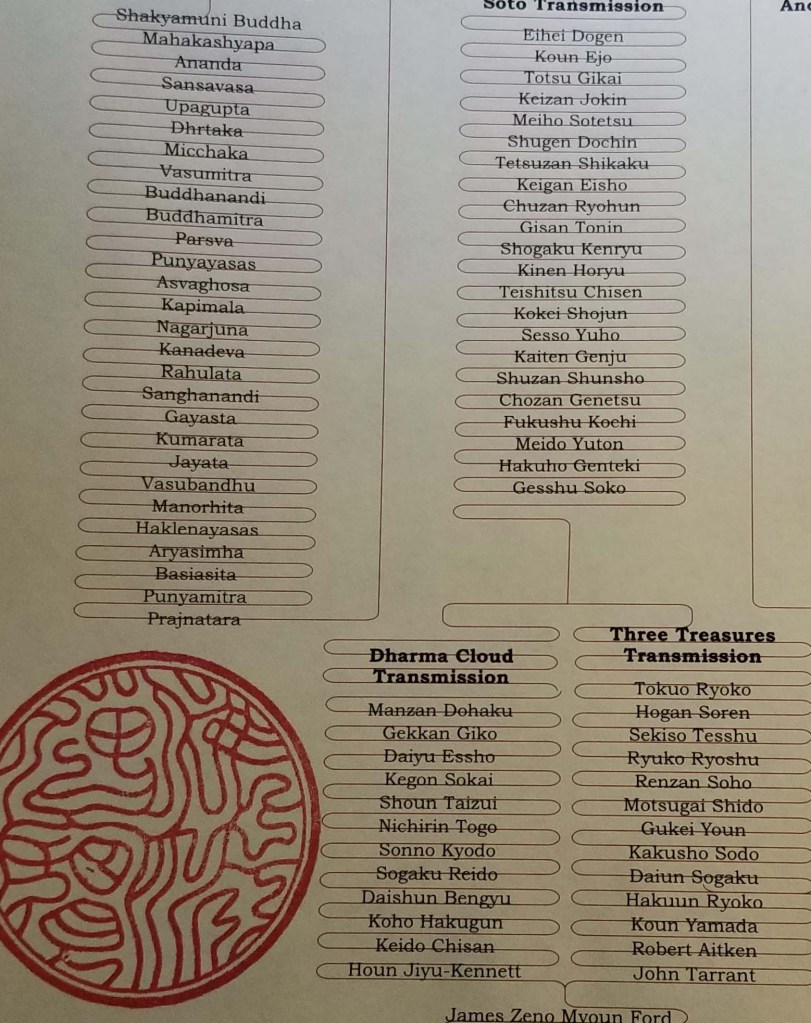
Lineage charts (kechimyaku) play important roles in Zen ceremonies. These purport to show a direct line of transmission all the way from Shakyamuni Buddha, through ancestors in India, China, and elsewhere, and ending with the recipient of the chart. A red “bloodline” connects the names. The word patriarchs, from the Greek for “ruling father,” is traditionally synonymous with ancestors, since all but some very recently recognized ancestors are men.

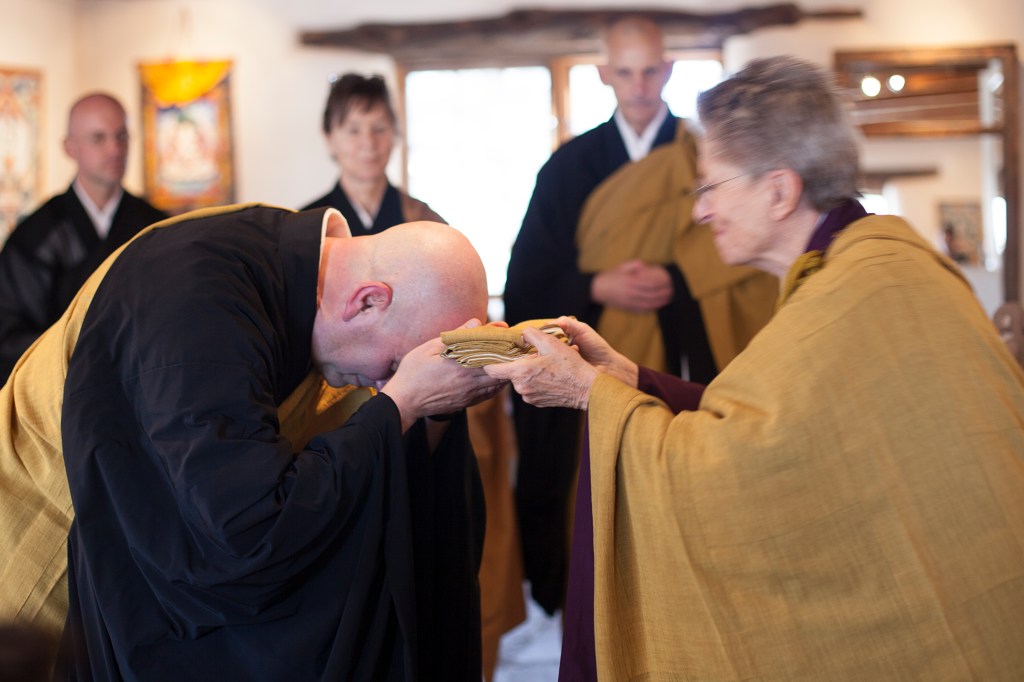
Students receive a lineage chart when we receive the  Buddhist precepts (ethical teachings) in the ceremony of Jukai. The relevant use of the term transmission for this discussion, however, is at the ceremonies of teaching transmission from a fully transmitted teacher to their “Dharma heir.”  A teacher who receives full transmission becomes an “ancestor” themself if they convey teaching authority on to further “heirs.” 

Continue reading “What is Transmitted: (3) Patriarchal Authority?”

What is Transmitted (2) A Special Mystical Power?

Zen teachers are said to have received “mind to mind” transmission. What does that mean?

We speak of “mind to mind” transmission of the Dharma. This can be confusing. I remember hearing that a rumor circulated among the students of a well-known abbot: The act of teaching transmission, supposedly, involved the teacher pouring something special into the successor’s brain by means of them sitting for a long time with their heads pressed together.

Even if we aren’t as literal-minded as that, the fact that teaching transmission traditionally happens in a ceremony conducted at midnight, privately and in the teacher’s own quarters, may get us thinking that some thing in the mind has been mysteriously transferred

Much more helpful, I believe is Keizan’s phrasing (see Part (1)) of “mutual recognition” in the room. In modern lingo, we might say that the teacher and student have found themselves to be “on the same wavelength,”  and that transmission involves formal recognition of this.

Continue reading “What is Transmitted (2) A Special Mystical Power?”

What is Transmitted (1) Enlightenment?

Zen teachers are said to have received “transmission.” Does this mean that teachers are enlightened beings?

Most who enter Zen practice have done some reading, and heard about enlightenment, awakening, realization, and opening experiences, or perhaps heard their Japanese terms, kensho and satori. Bodhidharma, the first Chan ancestor in China, is said to have written:

A special transmission outside the scriptures,
Not founded upon words and letters.
By pointing directly to one’s mind,
It lets one see into one’s own true nature and thus attain Buddhahood.

So a good first guess at what “transmission” means is that “transmitted teachers” have “seen into their true nature” and received “enlightenment.” And, one may then conclude, that if one is a good enough student your teacher may someday “transmit” enlightenment to you. Many Zen stories about interactions between teachers and their Dharma heirs (and especially those in Keizan Jokin’s The Record of Transmitting the Light) end, after all, with “On hearing this, the [Dharma successor] was greatly awakened.”

Continue reading “What is Transmitted (1) Enlightenment?”

What is Transmitted in Zen Teaching “Transmission”?

Teaching transmission is a big deal in Western Zen sanghas. But what does it mean?

I became a “transmitted Zen teacher” during a period of great crisis and questioning in my home Zen sangha. So I’ve had a lot of reasons to think about what, exactly, teaching “transmission” means.

It turns out that there is a great deal of disagreement about this. I’m not a scholar of Zen history, and I’m not going to try to sort all that out. (The Wikipedia article on it gives a useful summary of some of the controversies.) My concern is more practical: What does “transmission” mean for me as a teacher in Boston, Massachusetts, USA, in the early 2020s, and for the teachers and students in my home sangha? Can reflection on this be of assistance to other teachers and sanghas?

Continue reading “What is Transmitted in Zen Teaching “Transmission”?”

Self-Policing Doesn’t Work

Self-policing of conduct hasn’t worked for police forces, the military, or the Catholic Church. Why, then, would we think it should work for Buddhist teachers?

The sanghas I’ve been a part of have had groups of senior teachers, instead of just one, at least in part on the philosophy that teachers are less likely to abuse trust when other teachers are watching them. Nice idea. Doesn’t actually work.

Continue reading “Self-Policing Doesn’t Work”

Any Spiritual Teacher Can (and Likely Will) Cause Harm

No human is perfect. The question is whether our less-than-skillful uses of power will be minor or devastating.

Sometimes teacher misconduct is thought of as something committed by only a very few “scoundrels and sociopaths” (source of quote: open letter signed by 90 senior Zen teachers). Yet if we stay uninformed about teacher power and do not use it with extreme care, it is not only possible but likely that we will end up misusing it ourselves.

The longer I’ve been practicing, the more fellow practitioners I find who are on their second, third, or fourth spiritual community…or have given up entirely. They encountered teachers who acted like bullies. Or know-it-alls. Or who spread around things told to them in confidence. Or demanded complete, unquestioning loyalty. Who misspent funds, lied to authorities and to the sangha, or, yes, pushed sexual boundaries. Or simply did little things that made a student feel “icky” one too many times.

Continue readingAny Spiritual Teacher Can (and Likely Will) Cause Harm

Spiritual Teachers are Prone to Creeping Ego-Inflation

If WE believe we’re humble, we must be humble. Right? (Well, maybe not…)

“I’ve seen the kind of teachers who pretend to be above it all,” you probably say and nod, “but I’m not one of them.” Please consider the following:

Often we don’t notice the buildup of pride, which grows out of commendable self-confidence, but then climbs unnoticed until we find that we are stiffly defending our position and our patch. An old Hasidic teacher compared the unnoticed inflation of pride to taking a journey by carriage. We look out of the window and swear that the country-side is level. Only when we begin the sharp descent do we realize the preceding slow climb of our pride.

Ross Bolleter, Dongshan’s Five Ranks: Keys to Enlightenment, p. 183.
Continue readingSpiritual Teachers are Prone to Creeping Ego-Inflation

Boundary Violations Deeply Harm Individuals and Communities

When a spiritual teacher fails to put their students’ interest first, devastating spiritual and emotional harm can result.

A serious breach of trust or “boundary violation” occurs when a professional with specialized knowledge and power breaches the appropriate limits of the relationship between them and the person seeking their help.

Whether Buddhist teachers recognize ourselves as professionals or not, once we hang out our shingle (so to speak) as a spiritual leader we have made an implicit promise. Much like a therapist or lawyer, we have promised to always put the interests of the student (or congregant or client) ahead of our own. We have announced “Here, you will find a safe space.” We have said, “You can trust me.”

Continue reading “Boundary Violations Deeply Harm Individuals and Communities”

Naming (and Preventing) Psychopompogenic Harm

Harm caused by clergy and spiritual teachers is rampant. What can we—especially Buddhist and Zen teachers—do to prevent it?

When a patient is harmed by the actions of a medical provider, we call it iatrogenic harm. Iatros comes from the ancient Greek word for “healer “and genic means “caused by.” A psychopomp is a spiritual guide (Greek: psyche = soul, pomp = guide). So psychopompogenic harm means “harm caused by someone who offers spiritual guidance.” Abuse—sexual, emotional, spiritual, and financial—by clergy and spiritual teachers is rampant.

Sometimes it is dramatic and catches headlines. Other times it is more subtle, slowing damaging individuals and groups over decades. Whatever its form, it definitely deserves its own word. Identifying a problem is the first step towards addressing it.

OK, so I coined the word. A Google search on it says “no results found.” (Is there a prize for that?) But how do we recognize, respond to, and prevent it?

Continue reading “Naming (and Preventing) Psychopompogenic Harm”

Our Resilient Sangha

My sangha that has spent the last year and a half recovering from yet another case of Zen teachers’ abuse of power. We’d like to share what we learned.

In the late fall of 2020, our Greater Boston Zen Center (GBZC) sangha was still recovering—spiritually, emotionally, financially, organizationally—from our split with Boundless Way Zen (BoWZ) over issues of teachers’ abuse of power. Then, just before Thanksgiving, a new issue came up for our now-separate group: Our GBZC Spiritual Director engaged in year-long secret emotional and sexual misconduct with one of his students.

Continue reading “Our Resilient Sangha”