Practicing Safe Zen

The liberation that Zen offers is real! Yet, as I explain in my book, Zen practice must be engaged with carefully.

Practicing Safe Zen (cover)


“Practicing Safe Zen imparts a lesson we all will have to learn if we want to truly mature in our spiritual practice…” —Barry Magid, author, Ending the Pursuit of Happiness

“…This is a thoroughly engaging exploration based on deep knowledge of the tradition as well as contemporary research.” Martine Batchelor, author, Principles of Zen 

The book was released in June 2025, and is can be purchased from Indiepubs and other booksellers. With the publisher’s permission, I’ve reproduced (most of) the introduction below. I hope you will be inspired to read the rest!

Continue reading “Practicing Safe Zen”
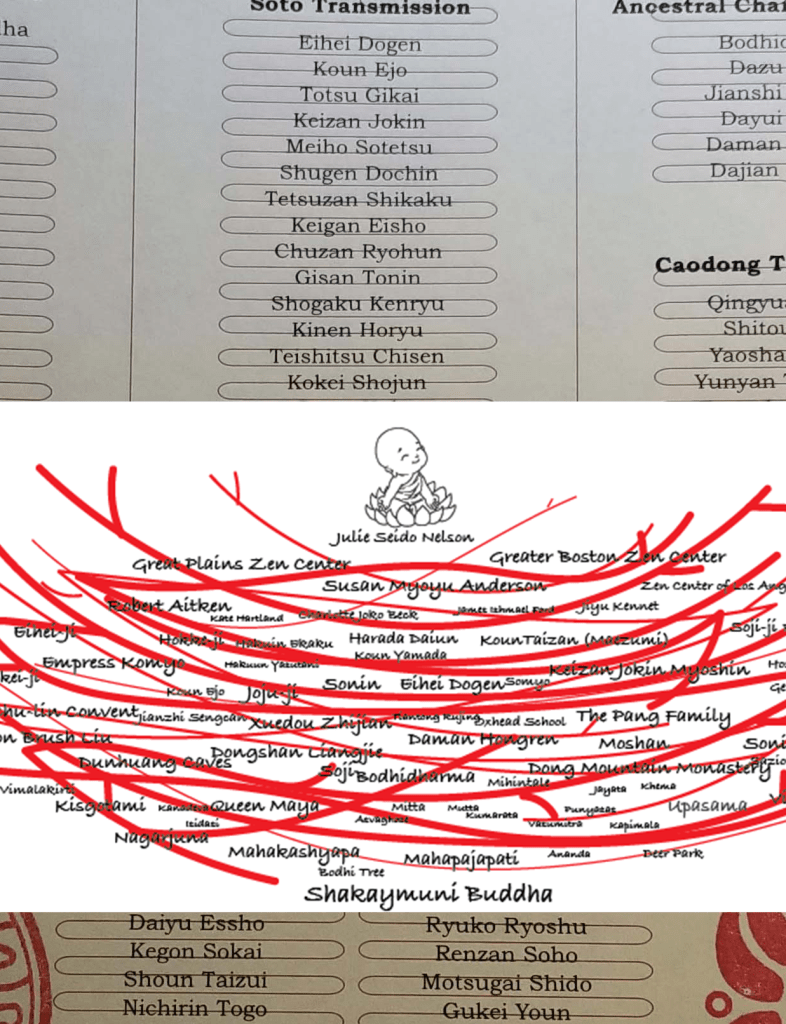
Ancestry Without Lineage

The traditional Zen emphasis on patriarchal lineage is problematic. What if we recognized all who have nurtured us instead?

We are able to practice Zen today because of many the people, places, and communities that sustained the tradition in the past. We do well to remember and honor our Zen history. In the commercialized Western culture in which I live, it’s far too easy to become enamored of Zen as “the next new thing!” We may lean towards forgetting that it’s an ancient tradition.

Yet the way in which this honoring is traditionally done in Zen is highly problematic.

Continue reading “Ancestry Without Lineage”

The State of the Sangha

We have met with seemingly endless retaliation for calling attention to abuses of power in Zen. Yet we are surviving and flourishing.

It’s been a crazy time, since my last post. That post, and another attempt of mine to engage in discussion about abuses in Zen, brought forth an unexpected firestorm of angry responses from the three other teachers at Greater Boston Zen Center.

Continue reading “The State of the Sangha”

Spiritual Teachers Need to be Clear About What We Offer

Students assume that spiritual teachers will act with the sort of wisdom and compassion that we teach about. But what happens when expectations and reality collide?

Upon finding out that our Spiritual Director had engaged in a year-long secret emotional and sexual involvement with a student, many members of our Zen sangha felt emotionally crushed and spiritually adrift. Our trust in him, and even in the Dharma, had been badly violated. We reached out for understanding and help from our remaining teachers.

Continue reading “Spiritual Teachers Need to be Clear About What We Offer”

Self-Policing Doesn’t Work

Self-policing of conduct hasn’t worked for police forces, the military, or the Catholic Church. Why, then, would we think it should work for Buddhist teachers?

The sanghas I’ve been a part of have had groups of senior teachers, instead of just one, at least in part on the philosophy that teachers are less likely to abuse trust when other teachers are watching them. Nice idea. Doesn’t actually work.

Continue reading “Self-Policing Doesn’t Work”

Any Spiritual Teacher Can (and Likely Will) Cause Harm

No human is perfect. The question is whether our less-than-skillful uses of power will be minor or devastating.

Sometimes teacher misconduct is thought of as something committed by only a very few “scoundrels and sociopaths” (source of quote: open letter signed by 90 senior Zen teachers). Yet if we stay uninformed about teacher power and do not use it with extreme care, it is not only possible but likely that we will end up misusing it ourselves.

The longer I’ve been practicing, the more fellow practitioners I find who are on their second, third, or fourth spiritual community…or have given up entirely. They encountered teachers who acted like bullies. Or know-it-alls. Or who spread around things told to them in confidence. Or demanded complete, unquestioning loyalty. Who misspent funds, lied to authorities and to the sangha, or, yes, pushed sexual boundaries. Or simply did little things that made a student feel “icky” one too many times.

Continue readingAny Spiritual Teacher Can (and Likely Will) Cause Harm

Spiritual Teachers are Prone to Creeping Ego-Inflation

If WE believe we’re humble, we must be humble. Right? (Well, maybe not…)

“I’ve seen the kind of teachers who pretend to be above it all,” you probably say and nod, “but I’m not one of them.” Please consider the following:

Often we don’t notice the buildup of pride, which grows out of commendable self-confidence, but then climbs unnoticed until we find that we are stiffly defending our position and our patch. An old Hasidic teacher compared the unnoticed inflation of pride to taking a journey by carriage. We look out of the window and swear that the country-side is level. Only when we begin the sharp descent do we realize the preceding slow climb of our pride.

Ross Bolleter, Dongshan’s Five Ranks: Keys to Enlightenment, p. 183.
Continue readingSpiritual Teachers are Prone to Creeping Ego-Inflation

Boundary Violations Deeply Harm Individuals and Communities

When a spiritual teacher fails to put their students’ interest first, devastating spiritual and emotional harm can result.

A serious breach of trust or “boundary violation” occurs when a professional with specialized knowledge and power breaches the appropriate limits of the relationship between them and the person seeking their help.

Whether Buddhist teachers recognize ourselves as professionals or not, once we hang out our shingle (so to speak) as a spiritual leader we have made an implicit promise. Much like a therapist or lawyer, we have promised to always put the interests of the student (or congregant or client) ahead of our own. We have announced “Here, you will find a safe space.” We have said, “You can trust me.”

Continue reading “Boundary Violations Deeply Harm Individuals and Communities”

Naming (and Preventing) Psychopompogenic Harm

Harm caused by clergy and spiritual teachers is rampant. What can we—especially Buddhist and Zen teachers—do to prevent it?

When a patient is harmed by the actions of a medical provider, we call it iatrogenic harm. Iatros comes from the ancient Greek word for “healer “and genic means “caused by.” A psychopomp is a spiritual guide (Greek: psyche = soul, pomp = guide). So psychopompogenic harm means “harm caused by someone who offers spiritual guidance.” Abuse—sexual, emotional, spiritual, and financial—by clergy and spiritual teachers is rampant.

Sometimes it is dramatic and catches headlines. Other times it is more subtle, slowing damaging individuals and groups over decades. Whatever its form, it definitely deserves its own word. Identifying a problem is the first step towards addressing it.

OK, so I coined the word. A Google search on it says “no results found.” (Is there a prize for that?) But how do we recognize, respond to, and prevent it?

Continue reading “Naming (and Preventing) Psychopompogenic Harm”

Our Resilient Sangha

My sangha that has spent the last year and a half recovering from yet another case of Zen teachers’ abuse of power. We’d like to share what we learned.

In the late fall of 2020, our Greater Boston Zen Center (GBZC) sangha was still recovering—spiritually, emotionally, financially, organizationally—from our split with Boundless Way Zen (BoWZ) over issues of teachers’ abuse of power. Then, just before Thanksgiving, a new issue came up for our now-separate group: Our GBZC Spiritual Director engaged in year-long secret emotional and sexual misconduct with one of his students.

Continue reading “Our Resilient Sangha”