Nonduality Part III: Relationships in Entity Thinking

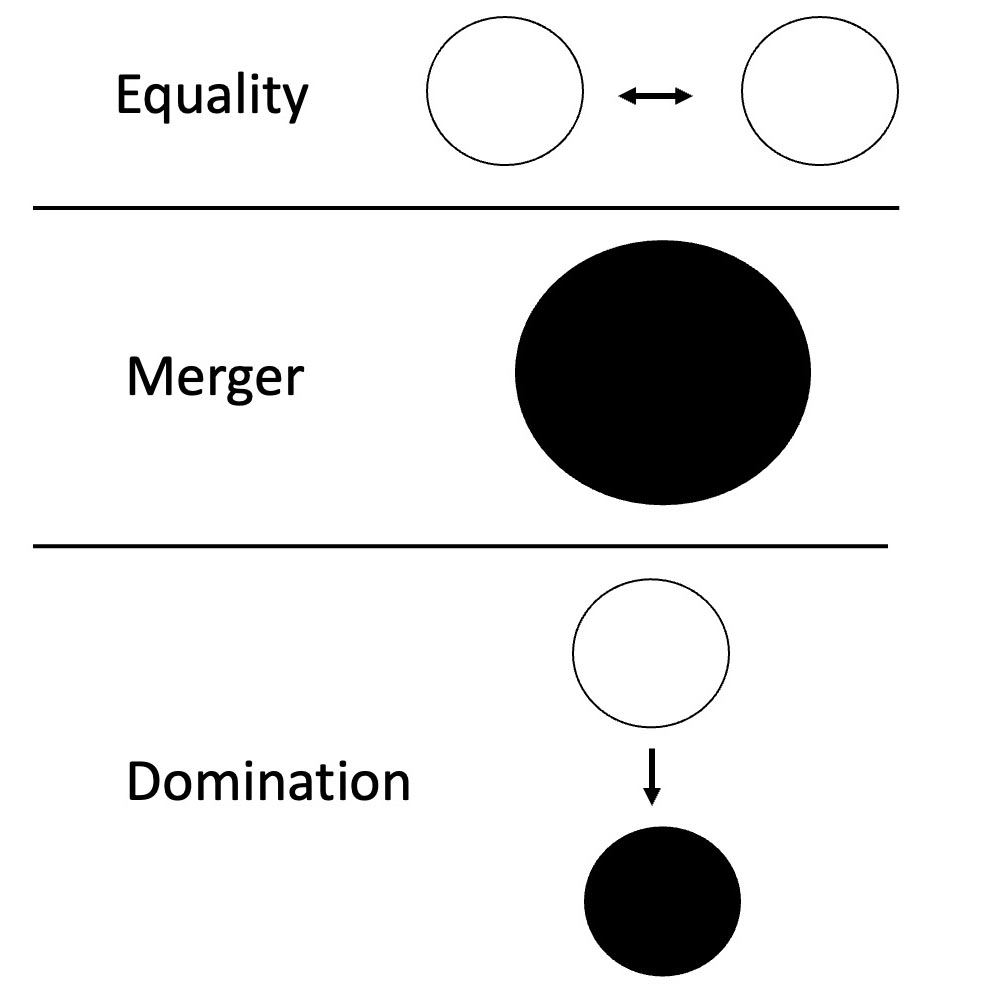
Our usual way of viewing the world as made up of entities that first exist and only later act and relate to each other constricts our thinking. Within it, we can only image three ways of relating: equality, merger, or domination.

In the yin-yang diagram, both light and dark are necessary, and their relationship is dynamic. But in our habitual Western thought not only do we separate the two and think of them as fixed, we tend to associate light with superior and dark with inferior.

Continue reading “Nonduality Part III: Relationships in Entity Thinking”

Non-duality Part II: Yin-Yang

The yin-yang diagram illustrates how nonduality includes duality—but must be understood through dynamic “process” thinking rather than static “entity” thinking.

While the metaphor of the ocean (oneness) and the waves (many) that temporarily arise is a wonderful illustration of nondualism, it doesn’t spawn much further understanding. The ancient Chinese yin-yang diagram (shown here), associated with Daoism, highlights more dimensions. 

Continue reading “Non-duality Part II: Yin-Yang”

Non-Duality Part I: Entity vs. Process Thinking

To understand nonduality, we have to take a step backward and look at the fundamentals of how we think about the world. If we take an “entity” view, it makes no sense. If we understand the world as “process,” though, we can see that this is, in fact, the reality of our life.

Abide not in duality,
refrain from all pursuit of it.
If there’s a trace of right and wrong
true-mind is lost, confused, distraught…

From One-mind comes duality,
but cling not even to this One…

These verses are from the Zen sutra entitled “Affirming Faith in Mind” (“Xinxinming” by Jianzhi Sengcan).

Continue reading “Non-Duality Part I: Entity vs. Process Thinking”

Wanting (to be Rid of Pain)

Pain and the desire to be rid of pain arise. What do we do with them?

I recently fell into a trap. I had just read in a Zen koan, “When the mind seeks nothing, this is called the Way.” Yet I get recurrent periods of pain that do not respond to any of a variety of relatively safe pain medications. My mind was at that moment quite insistently seeking relief from the pain. So my thought chain then continued, “Why can’t I get rid of this wanting to get rid of the pain? I must be a bad Zen student.”

Continue reading “Wanting (to be Rid of Pain)”

What If ‘Capitalism’ Isn’t the Problem?

A few days ago, I was interviewed by Oshan Joshan for his podcast series “Musing Minds.” We talked about both economics, Zen, gender…so on some of the same themes I’ve addressed elsewhere on this blog.

Oshan gave the interview the title “What If ‘Capitalism’ Isn’t the Problem?” That’s not to say we don’t have enormous problems! Only that we have mis-identified their source.

Postscript to “Letting in Some Air”

It’s been over a year since I first posted about problems in the Boundless Way Zen community. While I had hoped “that we will all get through this together,” that is not what happened.

Broken-HeartIt’s been over a year since the last comment on my essay about problems in the Boundless Way Zen Community, Letting in Some Air, was posted. I think it’s time for a public postscript about what has happened since then.

Unfortunately, while I had hoped “that we will all get through this together,” that is not, in fact, what happened. David Rynick and Melissa Blacker’s insistence on their own unquestionable superior teaching authority, and the facilitation of their power grab by several senior students, led to a deep and painful schism. The other five Boundless Way Zen Guiding Teachers, many members, and a number of sitting groups ultimately left that organization over the fall of 2018 and early 2019. Most of us now affiliate with the Greater Boston Zen Center. David and Melissa continue to lead the Boundless Way Temple (BWT) and Boundless Way Zen (BoWZ). Continue reading “Postscript to “Letting in Some Air””

How Do I Live My Life?

Is this a problem that cries out for a solution? Or an invitation to investigation?

grassThe question “How do I live my life?” has been coming up for me lately. I’ve been exploring  two versions of it.

The first version arises as a cry from the heart: “How do I live my life?”

Life has difficulties. Continue reading “How Do I Live My Life?”

A Caution about Sent and van Staveren’s “Feminist Review…”

While the conclusions it comes to are broadly correct, the article “A Feminist Review of Behavioral Economic Research on Gender Differences” by Sent and van Staveren should not be used as a model for methodology.

Sent and van Staveren FEIn their article “A Feminist Review of Behavioral Economic Research on Gender Differences,” published in the April 2019 issue of Feminist Economics, Esther-Mirjam Sent and Irene van Staveren state that their work was inspired by my own work. In a series of articles (here, here, and here) and a book, I had performed meta-analyses of behavioral economics work concerning gender and risk-taking. Sent and van Staveren are to be commended for taking on the ambitious project of extending the focus to include investigations into not only risk, but also overconfidence, altruism, and trust. They also come to conclusions that are, based on my own investigation, broadly correct: “[F]ew studies report statistically significant as well as sizeable differences,” “large intra-gender differences (differences among men and differences among women) exist,” and “[m]any studies have not sufficiently taken account of various social, cultural, and ideological drivers.”  I feel obligated, however, to point out that there are a number of methodological problems in their article. While the article is certainly notable, considerable caution should be exercised about taking its methods as a model for future work. Continue reading “A Caution about Sent and van Staveren’s “Feminist Review…””